
 Skip to main content
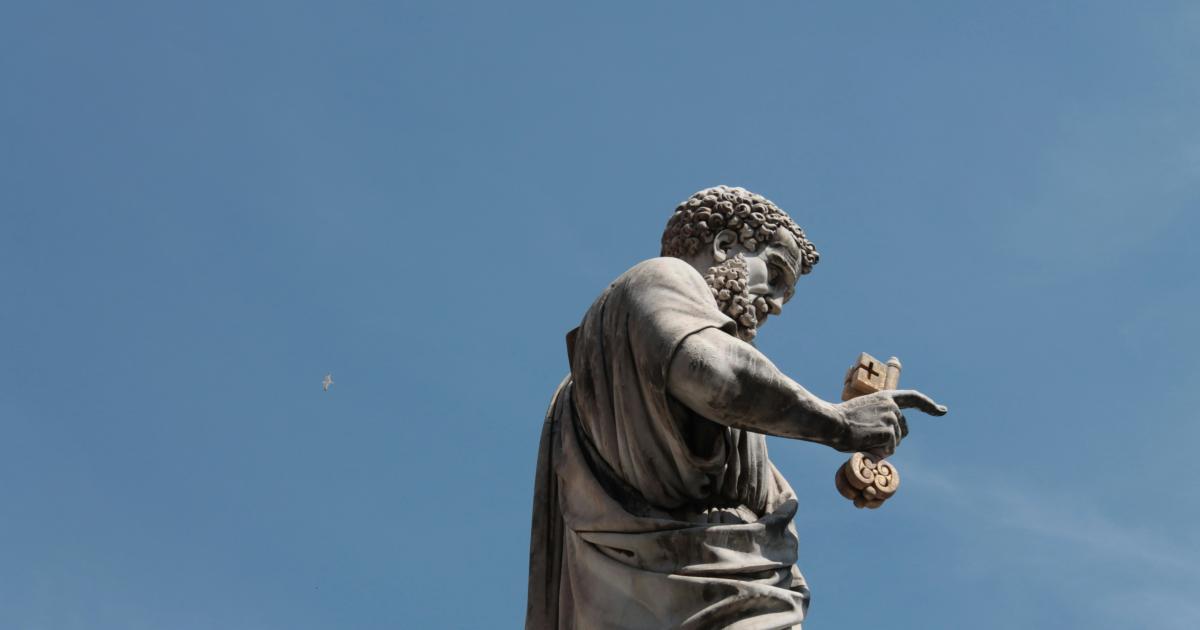
No. Let's look at Matthew 16:13-19. Jesus asked His disciples whom they thought He was, and Peter declared, "You are the Christ, the Son of the living God" (verses 15-16). Jesus called this a divine revelation (verse 17) and said: "You are Peter, and on this rock I will build My church . . . And I will give you the keys of the kingdom of heaven, and whatever you bind on earth will be bound in heaven, and whatever you loose on earth will be loosed in heaven" (verses 18-19). The terms "binding and loosing" were commonly used in Jewish teaching of making decisions to prohibit or permit.
Some interpret this to mean Peter was the rock the Church was founded on. However, the Greek word for "rock" here, petra, concerns a mass of rock, whereas the name Peter in Greek, Petros, refers to a smaller stone or boulder. Others argue Petros is simply the masculine name form of petra. Which is it?
The context of what Peter declared here is important-Jesus' identity as the Christ (or Messiah) and Son of God. The God of Israel was called the Rock (Deuteronomy 32:4; Psalm 42:9). And the apostle Paul referred to Christ as that Rock (1 Corinthians 10:4). Various prophecies referred to the Messiah as a stone and rock becoming the chief cornerstone (1 Peter 2:6-8).
So it's reasonable to conclude Jesus was referring to Peter as a small stone and then pointing to Himself as the rock on which He would build His Church-the foundation (see 1 Corinthians 3:11). Another view is that Peter's declaration of Jesus' identity was the foundation to build on. In Matthew 7:24-27, Jesus compared building a house on the rock with hearing and obeying His teachings. Both overlapping concepts may apply.
If there is any sense of Peter, a stone, as part of the foundation, it would only be through his connection to Christ. Yet that would not apply to him exclusively. Paul wrote that the Church is "built on the foundation of the apostles [plural] and prophets, Jesus Christ Himself being the chief cornerstone" (Ephesians 2:20).
Christ's focus in Matthew 16 was not on His own sole authority but on delegating responsibility. He gave the "keys of the kingdom of heaven." This language contrasts with His condemnation of religious teachers removing the key of knowledge to shut themselves and others out of entering God's Kingdom (compare Luke 11:52; Matthew 23:13).
What is the "key of knowledge" to entering the Kingdom? Paul told Timothy that the Holy Scriptures make us wise for salvation (2 Timothy 3:15). Jesus also said, "If you want to enter into life, keep the commandments" (Matthew 19:17). So the key is following God's Word-through the living Word, Jesus Christ!
The binding and loosing authority was part of using the keys of the Kingdom. The key of knowledge, from the truth of God's Word, would be used to make these decisions. Where Jesus is recorded as saying what is bound on earth "will be bound" in heaven, it should say "will have been bound," as various translations note. Same with loosing. Thus, He was talking about applying principles that already exist in God's Word. The keys, then, refer to understanding and applying God's truth-and teaching this to others.
This authority wasn't exclusive to Peter. Though Jesus spoke directly to Peter in the singular in Matthew 16, He did not establish Peter as a singular authority. Indeed, he was quite fallible. Just after this passage, in verses 21-23, Peter rebukes Jesus, and Jesus calls him "Satan" and an "offense" for thinking like men rather than God. Hardly an endorsement of papal supremacy!
In Matthew 18:15-20, in the context of resolving offenses, Jesus gives the same binding and loosing authority in the plural to all the apostles, not just Peter, noting that where two or more are gathered He would be with them-that is, in their judgment. This shared authority would, by extension, pass on to their successors in the ministry through the centuries.
So why was Peter singled out in Matthew 16 ? Jesus was responding to his forthright declaration and noting his significant role. Peter being first to proclaim Jesus' identity was characteristic of his bold, charging-ahead personality, a natural leadership quality. Peter is always listed first among the apostles. He had a clear leading role, but he was not over the other apostles, able to overrule them. He was not the chief apostle, that distinction belonging to Christ (Hebrews 3:1).
Yet Peter had a special role, and Christ's statement to him about the keys of the Kingdom may have hinted at the inaugural work Peter would do in advancing the Church's mission. In Acts 2, Peter gave the first sermon, resulting in the conversion of many Jews. Later, in Acts 10, Peter was used to open the door for the gentiles by baptizing Cornelius' household-then making the case to the Judean Church members in chapter 11. (Note he needed to convince them, not just rule on it.) So Peter played a crucial role in opening the way for the Jews and gentiles to come into the Church and ultimately the Kingdom.
While Peter did have a leading role in preaching to the Jewish people (Galatians 2:7-9), he was not some supreme infallible pontiff. Paul even publicly confronted him for error and hypocrisy at one point (verses 11-14).
We can appreciate the special leadership and inaugural role Peter was given without imagining him some prince of the apostles. The papacy is not a continuation of the true apostolic office. Why would it have passed from Peter when he died to another elder in Rome if John, another of the original 12 apostles, was still alive then? It didn't. The papacy represents the succession of rule in a false religious tradition. Let's not be swayed to make a faithful servant of Christ into something he wasn't.
Related Information:
Table of Contents that includes "Did Christ Exalt Peter Above the Other Apostles?"
Origin of article "Did Christ Exalt Peter Above the Other Apostles?"
Keywords: Peter the rock apostles
Peter:
- The Bible & Archaeology - The Book of Acts: The Church Begins
- Profiles of Faith - Peter: From Fisherman to Fisher of Men
- Walking on Water: Faith Over Physics
- Peter: From Fisherman to Faithful Fisher of Men
- Two Questions for a Disciple
- Hope Beyond the Moment
- The Testimony of the New Testament
- Profiles of Faith - Peter: From Fisherman to Fisher of Men
- Profiles of Faith - Paul, Apostle to the Gentiles
- Foundations
- What Did the Early Church Believe and Practice?
- Introduction: The Church Jesus Built
- What is the True Gospel?
- Did Jesus Really Die and Live Again?
- The Apostles, the Old Testament and God's Law
- Why is the Sabbath Commandment Not Repeated in the New Testament?
- Following in the Footsteps of the Apostles
- The New Testament Writers
- Foundations
- An Overview of Conditions Around the World - Jan/Feb 1997
- World News and Trends - Nov/Dec 1997
- Man of the Century: The Life and Times of Pope John Paul II
- Papal Power in Perspective
- Religious Deception in the Post Modern World
- World News Review Jan. 1999
- The Message of Mitch
- An Overview of Conditions Around the World - Jan/Feb 1999
- The Papacy: Growing Role in the Coming Years?
- World News Review June 1999
- Pope John Paul II Advocates Sunday Keeping
- Hitler's Pope: The Roman Church and the Third Reich
- Pope's Spiritual Journey Very Political
- Papal Visit Highlights Middle East Problems
- World News Review January 2001
- An Overview of Conditions Around the World - Jul/Aug 2001
- World News Review Nov 2001
- Beware of Prophecies!
- World News Review Jan 2002
- World News Review Feb 2002
- An Overview of Conditions Around the World - Sep/Oct 2002
- The Man Who Would Be Pope
- World News and Trends - Jan/Feb 2005
- A Celebrity Pope
- Which Way Europe?
- Death of a Titan: John Paul II's Impact on Europe and the World
- Pope Benedict XVI Faces Major Challenges
- A Page on the World: The Rise of Benedict XVI
- European Demographics and Bible Prophecy
- World News and Trends - January/February 2007
- Pope Benedict XVI Puts His Church "on Edge"
- Papal Authority, Protestants and Prophecy
- World News and Trends - September/October 2007
- The "Christian Caesar"
- Europe and the Church, Part 7: Charlemagne, Father of Modern Europe
- The Making of Emperor and Empire
- Europe and the Church, Part 8...Otto the Great, Founder of the First Reich
- The Uneasy Relationship Between Church and State
- Rome's "Right Face"
- Europe and the Church, Part 9: Charles V's Empire Upon Which the Sun Never Set
- Pope Calls for New "World Political Authority"
- Europe and the Church, Part 12: A Period of Change for the Papacy
- The Vatican Pushes for a Global Political and Economic Authority
- A New Pope: Looking Ahead
- Pope Leo the XIV: A Man to Watch
- World News and Trends - Nov/Dec 1997
General Topics Index
Biblical References Index
Home Page of this site